Two Hundred Rhinos Babys Where Does Baby Rhino Two Horns
Facts About Rhinos
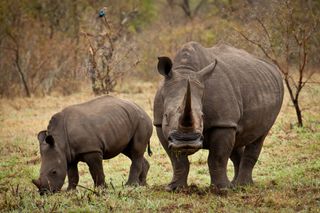
Rhinoceroses are big, herbivorous mammals identified by their feature horned snouts. The word "rhinoceros" comes from the Greek "rhinoceros" (nose) and "ceros" (horn). There are five species and 11 subspecies of rhino; some have two horns, while others take ane.
Because the animals' horns are used in folk medicine for their supposed healing properties, rhinos have been hunted almost to extinction. Their horns are sometimes sold as trophies or decorations, but more than often they are ground upwardly and used in traditional Chinese medicine. The powder is often added to food or brewed in a tea in the belief that the horns are a powerful aphrodisiac, a hangover cure and treatment for fever, rheumatism, gout and other disorders, co-ordinate to the International Rhino Foundation.
Conservation status
Salvage the Rhino estimates that in that location were 500,000 rhinos beyond Africa and Asia at the beginning of the 20th century. Today, the group says, there are 29,000 rhinos in the wild. Poaching and loss of habitat have put all rhinoceros species in danger of extinction. [Related: 2013 Was Record Twelvemonth for Rhino Poaching in South Africa]
Co-ordinate to International Union for Conservation of Nature'southward Red List of Threatened Species:
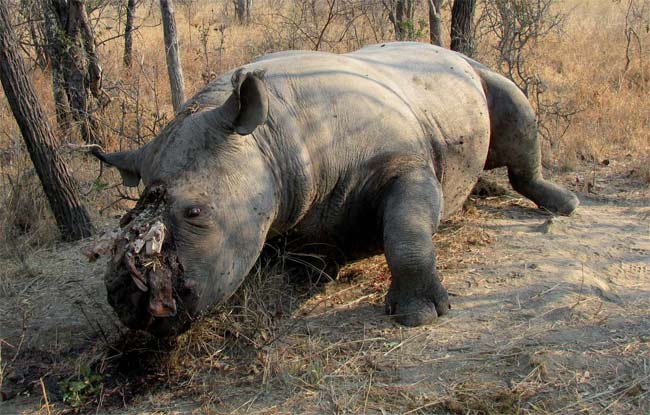
- Black rhinos, Sumatran rhinos and Javan rhinos are "critically endangered," which is the listing's highest risk category. There are 5,055 black rhinos, fewer than 100 Sumatran rhinos and only 35 to 44 Javan rhinos. [Related: Javan Rhino Officially Extinct in Vietnam]
- Greater i-horned rhinos are "vulnerable," which means they may become endangered unless circumstances improve. Fortunately, their population is increasing; at that place are 3,333 greater one-horned rhinos in the earth. The total population estimate in 2007 was 2,575 individuals, co-ordinate to the IUCN.
- White rhinos are "about threatened," which means they may be considered threatened by extinction in the near future. Southern white rhinos have an increasing population; in that location are 20,405 southern white rhinos. However, the northern white rhino is considered "extinct" in the wild.
In 2009, iv northern white rhinos were moved from a zoo in the Czech Republic to a individual conservancy in Kenya in the hope that they would breed, according to the IUCN. On Oct. 18, 2014, Ol Pejeta Conservancy announced that one of them, one of the last two breeding males, had died. He was not a victim of poaching, however, and the salvation was investigating the cause of death. On March 20, 2018, the conservancy announced the death of the last male northern white rhinoceros, Sudan.
There are now only two northern white rhinos left in the earth, both living in captivity, according to the World Wildlife Fund. The captive northern white rhinos are 2 females — Najin, Sudan's daughter, and Fatu, Najin's daughter — which live in the Ol Pejeta Conservancy in Kenya. The two females are incapable of a successful pregnancy: Najin is likewise one-time and issues with her legs make information technology impossible for her to support the weight of a mounting male; Fatu has a uterine condition that will probable keep her from breeding, according to experts.
With natural convenance attempts nixed for the northern white rhinos, conservationists take turned to in vitro fertilization. Yet, IVF in these rhinoceroses comes with its own fix of challenges, including figuring out how to get immature eggs to develop outside of the female'due south body and also how to inject sperm into these eggs.
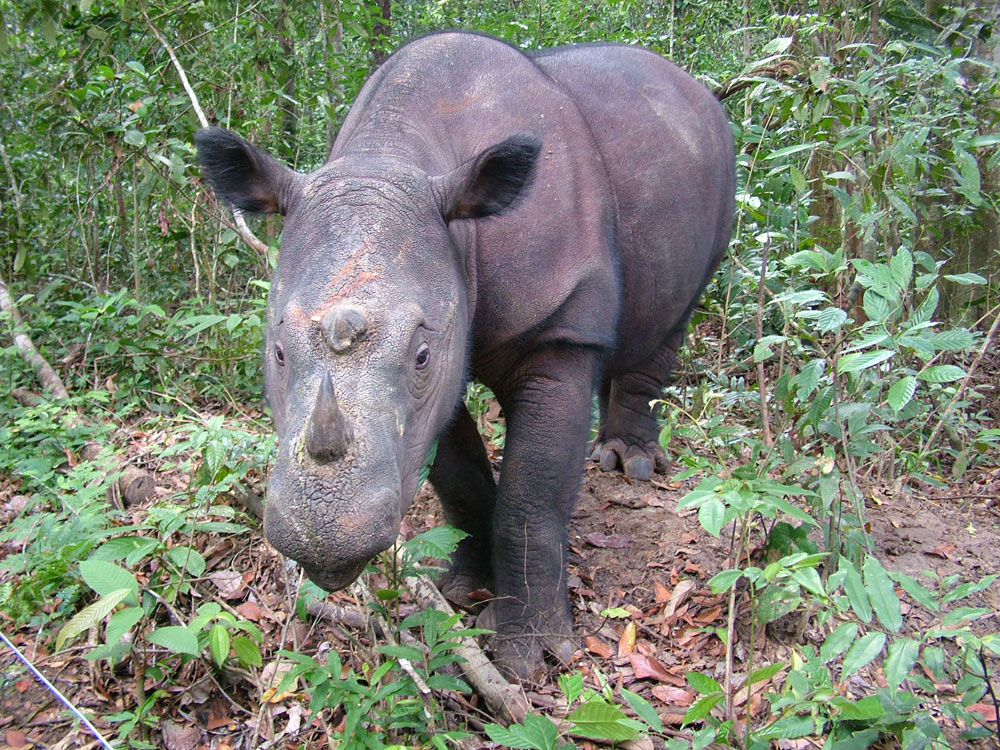
Every bit for the Sumatran rhinos, they are hanging on past a thread likewise. Along with the Javan rhino, Sumatran rhinos are barely hanging on in the wild. They went extinct in Vietnam in 2010 and in Malaysia in 2015, according to the International Rhino Foundation. Small populations of the subspecies survive in three national parks in Sumatra. And in March 2016, conservationists captured a live Sumatran rhinoceros in the Indonesian part of the island of Kalimantan for the first time. Though a camera-trap paradigm snapped in 2013 revealed Sumatran rhinos did survive in this region called Kalimantan, the capture of the female person marked the beginning time in 40 years that humans had physically contacted a live Sumatran rhino there.
Rhino horns
Rhinoceros horns are made of keratin, which is too the key component of human being hair and fingernails. Just the horns are non but dense clumps of hair. CT scans accept shown dense mineral deposits of calcium and melanin in the core of the horn. The calcium makes the horn stronger, and the melanin protects it from the sun's UV rays, according to scientists at Ohio University.
The horns are similar to horse hooves, turtle beaks and cockatoo bills, said Tobin Hieronymus, an OU doctoral student. Rhino horns tend to bend astern, toward the head, considering the keratin in front grows faster than the keratin in the back, Hieronymus told Alive Science. The exterior of the horn is rather soft and tin can be worn down or sharpened after years of use, according to the San Diego Zoo. If a horn breaks off, it tin can gradually abound dorsum.
Black rhinos, white rhinos and Sumatran rhinos accept two horns. Javan rhinos and greater 1-horned rhinos take i. On the black rhino, the forepart horn can grow to 20 to 51 inches (51 to 130 centimeters), while the rear horn can abound to nigh xx inches, according to the International Rhino Foundation. A white rhinoceros's horns are slightly smaller, and a Sumatran rhinos horns are nigh 10 to 31 inches (25 to 79 cm) for the forepart and less than 3 inches (7 cm) for the rear. The greater 1-horned rhino's horn is eight to 24 inches (20 to 61 cm), and Javan rhinos have a horn that is near 10 inches (25 cm) long.
How big are rhinos?
The largest rhinoceros species is the white rhino, co-ordinate to the San Diego Zoo. Information technology grows to 12 to 13 anxiety (3.7 to 4 meters) long and upwardly to 6 feet (1.8 m) from hoof to shoulder. It weighs around 5,000 lbs. (ii,300 kilograms).
The smallest rhino species is the Sumatran rhino. It grows to viii to 10 feet (2.5 to 3 grand) long and up to four.8 feet (1.5 m) from hoof to shoulder. The Sumatran rhino weighs around 1,765 lbs. (800 kg).
Habitat
White rhinos and black rhinos live in the grasslands and floodplains of eastern and southern Africa. Greater one-horned rhinos can be found in the swamps and rain forests of northern Bharat and southern Nepal. Sumatran and Javan rhinos are found merely in pocket-sized areas of Malaysian and Indonesian swamps and pelting forests.
Rhinos spend their days and nights grazing and only sleep during the hottest parts of the twenty-four hour period. During the rare times when they aren't eating, they can be institute enjoying a cooling mud soak. These soaks also help to protect the animals from bugs, and the mud is a natural sunblock, co-ordinate to National Geographic.
Though rhinos are often solitary, they practise occasionally form groups. Called crashes, these groups are made up of a female and her offspring. A dominant male rules over an area of land. The male volition allow some sub-boss males to alive on his territory. Females roam freely around several different territories.
Diet
Rhinoceroses are herbivores, which means they eat only vegetation. The type of vegetation they eat varies by species. This is considering their snouts are unlike shapes to accommodate dissimilar types of food, according to National Geographic. For case, the black rhino eats trees or bushes considering its long lips allow it to selection leaves and fruit from up loftier. The white rhino has a flat-shaped snout that lets it get closer to the ground for eating grass.
Offspring
Every ii and a half to v years, a female rhino will reproduce. Female rhinos carry their young for a gestation menstruation of 15 to 16 months. They ordinarily only have i baby at a fourth dimension, though they do sometimes take twins. At birth, infant rhinos, which are called calves, are still quite big, at 88 to 140 lbs. (xl to 64 kg), according to the San Diego Zoo.
At around 3 years erstwhile, the calf volition set out on its own. A rhino tin can live upwards to 45 years.
Classification/taxonomy
According to the Integrated Taxonomic Information System (ITIS), the taxonomy of rhinos is:
Kingdom: Animalia Subkingdom: Bilateria Infrakingdom: Deuterostomia Phylum: Chordata Subphylum: Vertebrata Infraphylum: Gnathostomata Superclass: Tetrapoda Class: Mammalia Subclass: Theria Infraclass: Eutheria Gild: Perissodactyla Family unit: Rhinocerotidae Genera & species:
- White rhinos: Ceratotherium simum (southern white rhinoceros), Ceratotherium cottoni (northern white rhinoceros). IUCN lists these as subspecies of Ceratotherium simum.
- Sumatran rhinos: Dicerorhinus sumatrensis (also called hairy rhino, Asian 2-horned rhinoceros). Subspecies: Dicerorhinus sumatrensis harrisoni, Dicerorhinus sumatrensis lasiotis, Dicerorhinus sumatrensis sumatransis
- Black rhinos: Diceros bicornis (black rhino).Subspecies: Diceros bicornis bicornis, Diceros bicornis brucii, Diceros bicornis chobiensis, Diceros bicornis ladoensis, Diceros bicornis longipes, Diceros bicornis michaeli, Diceros bicornis minor, Diceros bicornis occidentalis
- Javan rhinos: Rhinoceros unicornis
- Greater one-horned rhinos: Rhinoceros sondaicus (too called Indian rhino). Subspecies: Rhinoceros sondaicus annamiticus, Rhinoceros sondaicus inermis, Rhinoceros sondaicus sondaicus
Other facts
Though rhinos don't often hang out with each other, they practice hang out with birds. The oxpecker will sit on a rhino'southward back and eat the bugs that crawl on the rhino's skin. That'south not the merely thing this bird is good for. When danger approaches, the bird will phone call out, warning the rhino.
When rhinos are happy, they brand a loud "mmwonk" audio with their mouths.
Blackness rhinos are not really black, co-ordinate to the International Rhino Foundation. They probably got that proper name from the nighttime, muddied soil they like to wallow in or to distinguish them from white rhinos.
Poachers also value rhino horns for making ornamental dagger handles called jambiyas, according to Save the Rhino. This blazon of handle became a status symbol in Yemen in the 1970s and '80s, fueled by the oil smash, when more than people could afford luxury items. Jambiyas tin exist made from precious metal, buffalo hide or plastic, but those made from rhinoceros horn were considered the "Rolex" version. Save the Rhino reports that this apply of rhino horn has accounted for fewer poaching incidents in recent years.
The woolly rhino died out virtually 10,000 years ago. Fossils have been discovered throughout Europe and Asia, according to the International Rhino Foundation. Early humans hunted these animals, and they were depicted in paintings on cave walls in France thirty,000 years agone.
Additional resources
- International Rhinoceros Foundation
- Save the Rhino
- Ol Pejeta Salvation

Alina Bradford is a contributing author for Live Scientific discipline. Over the past 16 years, Alina has covered everything from Ebola to androids while writing wellness, science and tech articles for major publications. She has multiple health, safe and lifesaving certifications from Oklahoma Country University. Alina's goal in life is to try every bit many experiences as possible. To date, she has been a volunteer firewoman, a dispatcher, substitute instructor, artist, janitor, children'south book author, pizza maker, event coordinator and much more.
romanfamenceromed.blogspot.com
Source: https://www.livescience.com/27439-rhinos.html
0 Response to "Two Hundred Rhinos Babys Where Does Baby Rhino Two Horns"
Postar um comentário