Do Babies Cheeks Get Red When They Are Teething
Fact Checked
This Dr. Axe content is medically reviewed or fact checked to ensure factually authentic information.
With strict editorial sourcing guidelines, nosotros only link to academic enquiry institutions, reputable media sites and, when research is available, medically peer-reviewed studies. Note that the numbers in parentheses (1, 2, etc.) are clickable links to these studies.
The information in our articles is Not intended to replace a one-on-one relationship with a qualified wellness care professional and is not intended as medical advice.
This commodity is based on scientific show, written by experts and fact checked by our trained editorial staff. Notation that the numbers in parentheses (i, 2, etc.) are clickable links to medically peer-reviewed studies.
Our team includes licensed nutritionists and dietitians, certified health pedagogy specialists, as well equally certified force and conditioning specialists, personal trainers and corrective practise specialists. Our team aims to exist non only thorough with its research, but too objective and unbiased.
The information in our articles is NOT intended to supercede a one-on-one relationship with a qualified health care professional and is non intended as medical advice.
Ease Your Babe'southward Teething Symptoms with 6 Natural Remedies
September 5, 2017
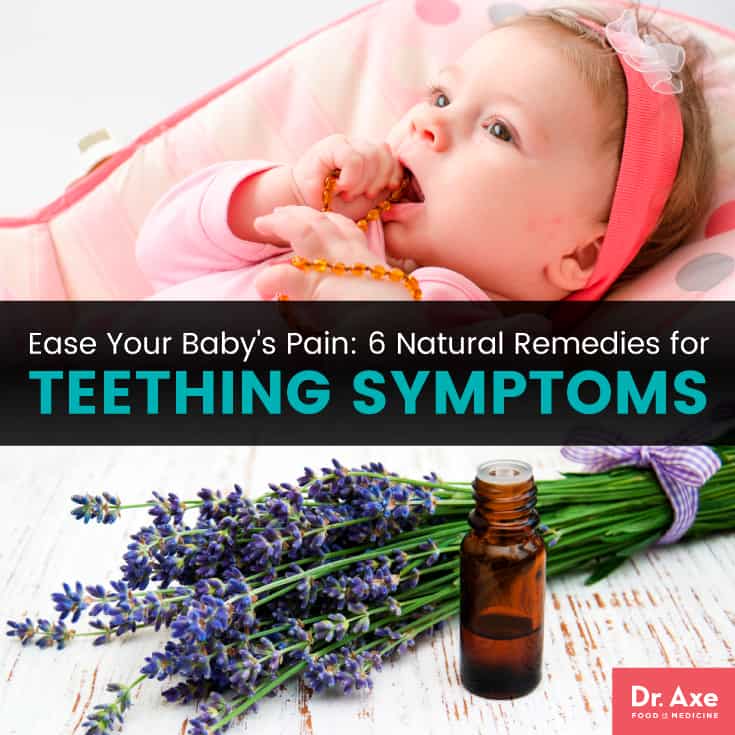
All babies accept to become through it, simply, unfortunately, teething is a common cause of temporary pain and suffering during a babe'due south early stages of life. Because not every infant's temperament is the same, babies tin show a variety of signs and symptoms every bit they pass through the unlike stages of concrete development. Parents oftentimes feel bad for their teething baby, anxious most when the pain will end, and curious about what they tin can do to help minimize their baby'due south uncomfortable teething symptoms.
How exercise you know if your baby is in fact teething? And if they are, what tin can you practise as a parent to help? Every bit you'll learn more most below, teething remedies include soothing your baby via impact or gentle massage, applying topical gels to their gums, and using herbal medicines to assistance dull the pain.
What Is Teething?
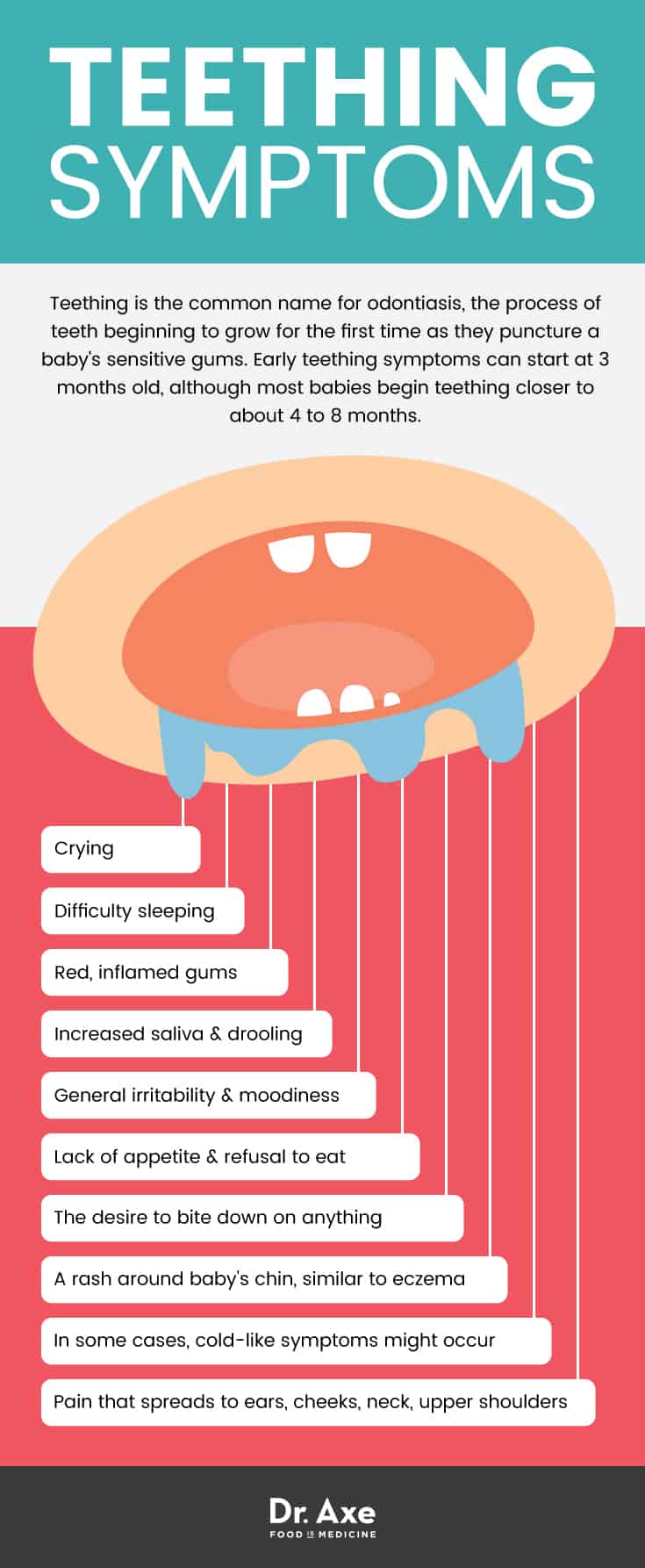
Teething is the common name for odontiasis, the process of teeth starting time to grow for the first fourth dimension as they puncture a infant's sensitive gums. (i) "Baby teeth" commonlyappear in a item sequence, ofttimes growing in pairs. Babies actually have a prepare of well-nigh xx teeth that they are born with; notwithstanding, the teeth remain under the gums until the odontiasis process begins. When does teething normally occur? And which baby teeth tend to come in first?
Early teething symptoms tin first at 3 months old, although about babies begin teething closer to nigh 4 to 8 months. (ii) Offset teething around 5 months old seems to be one of the most mutual times. The speed and sequence of odontiasis is believed to be mostly hereditary. This means that if a infant's parents started teething very young, the baby volition likely experience the same. There's also some prove that male babies may offset teething slightly later than females.
Teething symptoms, such as soreness, sensitive gums and pain can offset even before the baby'south teeth kickoff pushing through their gums. What practice teething gums look like? They will most likely look red, slightly raised in spots, puffy and a fleck swollen. (iii) If you suspect that your baby is starting to teethe, you can experience the inside of your baby's rima oris by running your finger gently along their gums. If y'all feel small bumps where the teeth are starting beetle into the gums, it'south very likely that your baby is in fact teething.
Typical Timeline of Baby Teething:
Here is an overview of what y'all tin can await to happen as your babe goes through the teething procedure:
- The kickoff teeth to come in are usually the "incisors," which are the iv forepart fundamental teeth. Many babies will first feel teething when their 2 lower central incisors come up in. This tends to occur around five–6 months onetime. Teething symptoms might begin at around 2–3 months old if your baby's incisor teeth start coming in early, but you likely won't see the actual teeth appear for 1 to ii more months.
- Between nigh half dozen–10 months information technology'southward common for babies to have their two upper fundamental incisors come through. Then over the following few months, normally between months 9–13, the two upper lateral incisors (located on the left and right side of the center) should come though. Once these announced the baby will have their 4 upper teeth.
- Information technology'due south typical for the lower lateral incisors (located on the bottom row, to the left and right of the center) to come up in later on the upper incisors. This commonly happens between about x–16 months.
- Molars are normally the next teeth to announced. These are four bigger teeth located at the back of the mouth. They are the final four teeth in the upper and lower rows, and so there are ii on the right side of the mouth and two on the left side. Later on, commonly at about 20–thirty months, 2nd molars will also grow in located at the rear sides of the mouth.
- In some cases, the teeth that fill in the spaces between the center and molars, chosen the canine teeth, will announced last. They may commencement coming in between about 16–22 months.
- Most babies accept their complete set of "baby teeth" by the fourth dimension they are 25–33 months (betwixt 2–3 years onetime).
Signs & Symptoms of Teething
Do babies become a fever when teething? Wondering if there might exist a connexion between teething and other symptoms your baby is experiencing, such as diarrhea or a runny nose?
While some "lucky" babies may not experience much pain at all during teething, virtually volition display at to the lowest degree some signs of discomfort. Information technology'southward common for babies to be crankier during the teething process, especially since they may non be able to slumber likewise due to discomfort. Once the teeth really puncture the gums and come through, teething symptoms should stop inside a couple of short weeks.
Some of the most common teething symptoms and signs include:
- Crying, especially at night or during the middle of the night (believed to be due to a lack of other stimulation/distraction).
- Blood-red, inflamed gums and soreness in the mouth.
- Hurting that appears to be spreading to other parts of the body, such as the ears, cheeks, cervix or upper shoulders. Sometimes babies will pull on their ears or rub their cheeks to effort and soothe the hurting.
- Difficulty sleeping, which tin affect their daytime schedule.
- Lack of appetite and refusal to eat. This may lead to under-eating or dehydration, which tin crusade symptoms similar diarrhea, runny stools or indigestion. Withal, if your baby has more than three runny stools per solar day it's probable that they are actually sick, not that teething is causing the trouble.
- Full general irritability and moodiness.
- Increased saliva and drooling.
- The desire to bite down on anything (fingers, toys, their parents easily etc.). Many babies will endeavour to grab objects to chew, or put anything they can get their hands on into their mouth, especially if the object is a bit hard or rubbery. This might seem counter-productive, merely gnawing on objects seems to really help relieve force per unit area in the gums.
- In some cases, cold-like symptoms might occur including mild coughing, runny nose, or red cheeks and ears. This can happen due to the babe putting their easily and objects into their mouth more. If these symptoms last more than two to three days, yous should see a doctor to identify what's causing the problem.
- A rash effectually your baby's mentum, which can look similar to eczema, due to increased drooling and touching their confront
Most doctors don't recognize fevers as a symptom of teething. If your baby appears to be sick with a fever and has a high body temperature, information technology's likely for another reason. Ever visit your doctor if your baby'due south temperature goes above 101 degrees Fahrenheit for more than one to ii days, as this indicates that they are ill.
Conventional Treatments for Teething
When your baby's teething symptoms become very uncomfortable, your physician might recommend giving him or her an over-the-counter pain reliever. I example is liquid acetaminophen, which can be safely given to babies in pocket-sized amounts in order to manage pain for about four hours. Most experts recommend only giving your infant painkillers when it's really necessary, usually only before they go to slumber in lodge to help them get improve residue.
Some doctors and parents also cull to apply soothing gels to their baby'south mouth in order to decrease swelling and tenderness. Popular types of gels include Orajel™ and Anbesol®. Gels tin launder off the gums somewhat apace, and then they don't provide relief for very long. They can be helpful on bad days when your baby is really having a hard time. Notwithstanding, note that these products incorporate benzocaine. The FDA warns confronting using this painkiller considering it can crusade a rare just serious medical condition. (4)
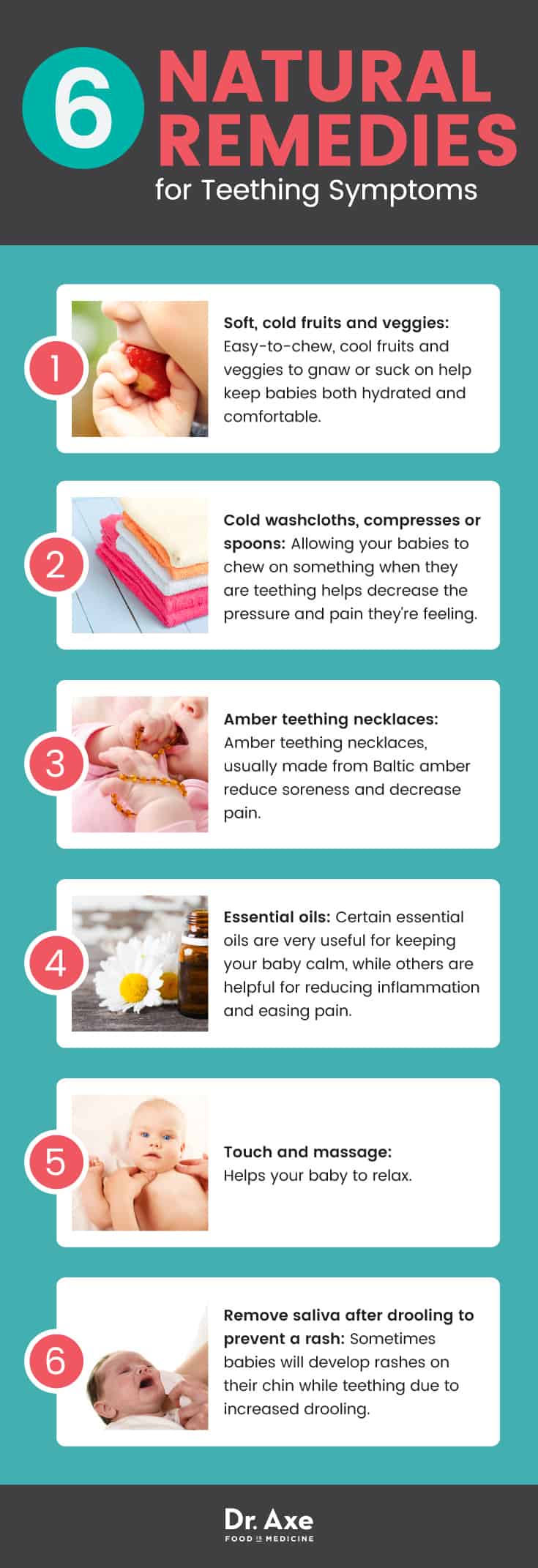
6 Natural Remedies for Teething Symptoms
Painkillers, massage therapy, topical gels, herbal medicines and home remedies tin aid reduce the pain and soreness.
i. Soft, Cold Fruits & Veggies
Giving your teething baby like shooting fish in a barrel-to-chew, cool fruits and veggies to gnaw or suck on is 1 of the best ways to keep them both hydrated and comfortable. Information technology's likewise like shooting fish in a barrel to make your own baby food, ensuring your giving your kid the all-time ingredients you can. Hither are some of the most pop types to try:
- Cold yogurt
- Natural applesauce (one of the easiest to make yourself!)
- Frozen assistant or pineapple. Only be sure to watch carefully that your baby doesn't choke.
- Cold carrots, celery, avocado or cucumber.
2. Cold Washcloths, Compresses or Spoons
Experts suggest that you allow your babies to chew on something when they are teething, since this helps decrease the pressure and pain they're feeling. (06) Give them a rubbery or wooden object that is make clean and nontoxic, or better yet make it a cold object. One instance of a chew toy is a wooden ring or doll that is used in Japan to soothe teething symptoms, sometimes called a kokeshi doll. To help lower swelling of your babe'south gums you can requite them something cold (and clean!) to chew on, such as:
- An ice towel. A unproblematic solution is wrapping several pieces of ice in a clean towel, tying a rubber band or knot into the towel to concord the ice, and then letting your baby suck on the towel. This way the ice melts simply doesn't become a choking take a chance.
- Another similar method is dipping a clean textile into cold water, wringing out excess h2o, and so putting the cloth in the freezer or refrigerator for a little while to chill. Let your baby bite down on the cloth, or apply it to their cheeks and chin.
- You also can try freezing your baby'southward pacifier or bottle nipple. To do this, fill a baby bottle and place in the freezer upside down, this way the h2o freezes at the nipple.
- Yet another option is to give your baby a very cold spoon to suck on. The coldness pressed against their gums can numb some of the pain and reduce inflammation. Identify a couple of spoons in the refrigerator for several hours then you have a common cold one set up when your babe needs information technology.
iii. Amber Teething Necklaces
Amber teething necklaces, normally made from Baltic amber, are worn effectually a babe's neck in order to reduce soreness and decrease hurting. Amber necklaces comprise an active ingredient called succinic acrid, which might accept a mild analgesic (numbing) effect. (seven) The theory behind bister necklaces is that when the baby's skin rubs against the necklace a small amount of the amber'due south oils seeps into their skin, helping to reduce inflammation and therefore discomfort. While in that location's loads of anecdotal evidence that bister necklaces are helpful, at that place'due south not testify showing they definitely piece of work. So it's ultimately up to the parents to make up one's mind if it'southward worth trying or not.
Most babies tolerate amber necklaces very well, although if the necklace breaks it can be a potential choking chance. Don't let your babe wear the necklace when he or she is out of your sight, such as when they are sleeping alone through the dark.
4. Essential Oils
Certain essential oils are very useful for keeping your baby calm, while others are helpful for reducing inflammation and easing pain. To help your baby slumber and relax when they're feeling uncomfortable, try diffusing lavender essential oil, chamomile or vanilla oil in their bedroom.
5. Touch on and Massage
It can assistance your baby to relax if yous physically bear on, gently massage, and soothe them. Distracting them with toys, games, attending or objects to play with besides works to subtract their fixation on the teething pain.
While they might exist uncomfortable with touching virtually their jaw or ears, try rubbing their dorsum and holding them if they are having a very hard teething day. If your baby allows, you tin assist reduce some of the pressure in their mouth by lightly massaging their gums, cheeks and ears. You may also want to try applying a very tiny corporeality of clove essential oil to their gums, which has natural numbing qualities and helps alleviate hurting. In fact, before anesthesia medications were available, clove oil was used to subtract toothaches and to ease other dental problems or procedures. (eight)
six. Remove Saliva After Drooling to Prevent a Rash
Sometimes babies will develop rashes on their chin while teething due to increased drooling. You can remove extra saliva with a soft cloth, helping to preclude the chin from becoming irritated or chapped. To treat your baby's rash (whether on their confront, or elsewhere such as their bottom) you can try applying natural products including kokosnoot or almond oil, shea butter, calendula and magnesium oil.
Precautions When Your Baby is Teething
While teething can cause a range of symptoms, including cold-like symptoms or irritability, it'south still best to visit your babe's pediatrician if symptoms persist for more several days. Symptoms of teething can mimic those caused past other illnesses, so don't ignore abnormal signs and symptoms your baby is displaying for long periods of time. Teething symptoms are usually not astringent enough to really affect your baby's health, and then consider whether another condition is really to blame if your baby is having a really hard time.
If you practise choose to give your baby a painkiller to reduce pain, exercise not give them products made with benzocaine or aspirin, as these are not recommended for teething babies since they may cause serious side furnishings in rare cases, including Reye's syndrome . (9)
To make sure that your baby is transitioning well through the teething process, the American Academy of Pediatric Dentistry and the American University of Pediatrics recommend that parents have their baby to his or her kickoff dental exam by age i.
Last Thoughts on Teething Symptoms & Remedies
- Teething (odontiasis) happens when a baby's teeth puncture their sensitive gums, usually beginning between 4–8 months old.
- Teething symptoms can include increased crying, painful gums, crankiness, trouble sleeping, swollen gums and chewing on hard objects.
- Natural teething remedies include giving your baby a cold object, cloth or foods to suck on, massaging their gums, distracting them, using essential oils to keep them at-home, and having them wear an amber necklace.
Read Next: What Is Paw, Foot and Mouth Disease? + 17 Natural Treatments
romanfamenceromed.blogspot.com
Source: https://draxe.com/health/teething-symptoms/
0 Response to "Do Babies Cheeks Get Red When They Are Teething"
Postar um comentário