Will the Days of Noah Happen Again
Introduction
The Bible (Genesis half-dozen–9) describes a worldwide flood (the Noachian Flood) covering even the highest mountains of the world and the structure of a huge boat (a rectangular box-like craft) that transported animals, at least two of a kind of all land animals on the earth. The Qur'an (Suras 11 and 71) has near a duplicate story with a similar huge boat that transported animals and a worldwide flood. In addition two older stories exist in ancient Babylonian epics that describe a huge flood. I is the Epic of Gilgamesh, describing a flood on the Euphrates River (Academy of Ancient Texts nd). The other is the Ballsy of Atrahasis, which has a huge inundation on the Tigris River (Byers nd).
In the Epic of Gilgamesh, [Utnapishtim] is warned that a god plans to destroy all humanity and is told to build a transport to save himself, his family unit, friends, and cattle. In the Epic of Atrahasis, a tribal main survived with his family by floating in a gunkhole down to the Persian Gulf. After the inundation subsided, the chief got out on dry out state and erected an altar and sacrificed to a water god so that such a flood would not happen once again (Anonymous nd-a). Noah too congenital an altar when he got off the Ark and offered sacrifices (Genesis 8:xx). Because these stories all describe an ancient huge flood in Mesopotamia, it is extremely probable that a huge flood could take occurred. All the same, the side by side question is: "Did the Noachian Flood encompass the whole earth?"
Scientific Evidence Against a Whole-World Flood
The Bible says that the rains that created the Noachian Flood lasted for 40 days (Genesis 7:17), that the waters prevailed on the globe for 150 days (Genesis 7:24), and after these 150 days the waters gradually receded from the globe so that by the seventh month and the seventeenth day, Noah'south Ark came to rest upon the mountains of Ararat (Genesis 8:4). A year plus ii months and twenty-seven days subsequently the earth was dry enough and then that Noah,his family, and the load of animals could disembark from the Ark (Genesis eight:14).
Considering this flood was intended by God to destroy all mankind on earth (Genesis 6:13) and because sedimentary rocks on all continents contain fossils that supposedly represent the "destroyed flesh of all life," it might be thought that the Bible story, describing a wholeearth flood, was true. However, interlayered with these fossil-begetting sedimentary rocks on all continents are layers of evaporite rock common salt (sodium chloride), gypsum (hydrated calcium sulfate), anhydrite (calcium sulfate), and various potash and magnesium salts, which are associated with red beds (shales) containing fossilized mud cracks (Schreiber and others 2007).
Many of these mineral compounds and red beds have combined thicknesses on dissimilar continents of more than one kilometer (~three,281 feet) (Collins 2006). The cherry-red beds are reddish because they contain red hematite (iron oxide) which formed from magnetite grains that were oxidized while the muds were exposed to oxygen in open air. The mud cracks can grade only nether drying conditions that crusade the mud to compress and form polygonal cracks. The evaporite mineral compounds in the layers are deposited in the right chemic order predicted by the solubility of each kind of ion in these compounds and whose increasing concentrations during the evaporation of water would cause them to precipitate in a predictable depositional sequence as the water volume decreased. Such evaporite deposits would be expected to occur where a marine body of water was once present and to disappear when the ocean became completely dry. Therefore, ane could expect these evaporites to be at the tiptop of the supposed Noachian Flood deposits when the water supposedly receded and the land dried out, merely certainly not in unlike levels in betwixt older and younger fossiliferous "Flood deposits".
Nosotros read in the Bible that there is merely ane time in which the Flood waters are said to recede and leave the globe dry. That is, no multiple worldwide climatic conditions are described in which flooding, and so drying to a dry earth, more flooding, more drying to a dry earth, in repeated cycles that occur over and over once more in that Flood year. On that basis, it is logical that all the kinds of evaporite deposits and red beds in many different levels in the supposed Noachian Flood deposits could class just in local climates with desert drying-atmospheric condition and could not maybe have formed all at the same time — a time when a overflowing covered the whole globe for more than one year (Collins 2006). On that footing, the Noachian Flood story cannot describe a whole-earth flood, but it could only represent a large regional flood.
Regional Prove for the Noachian and Similar Floods
2 rivers, the Euphrates and Tigris menstruum through Mesopotamia, which is now the land of Iraq (Figure ane). There are several layers in exposed rocks virtually these 2 rivers in southeastern Mesopotamia (Republic of iraq) that are likely flood deposits. Most are about a foot (0.3 m) thick, but ane is as much as 3 meters thick (MacDonald 1988). Flood droppings from this same thick deposit along the Euphrates River virtually the ancient Sumerian city of Shuruppak about 200 km southeast of Baghdad has been dated by the C
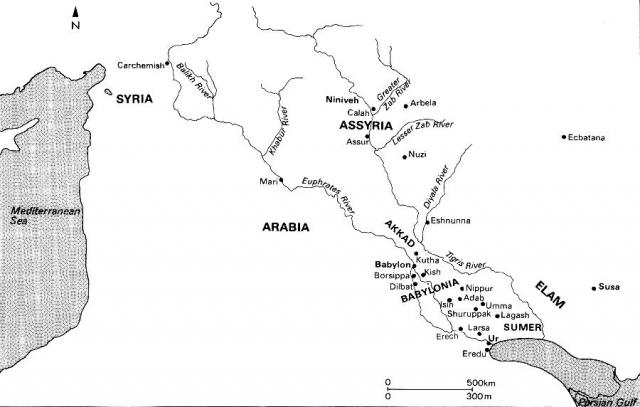
Effigy 1. Map of Mesopotamia (Republic of iraq).
Similar big local floods are mutual throughout history effectually the world. For example, monsoon storms in People's republic of bangladesh frequently produce much pelting over the country and in the Himalaya Mountains, which rising in the northern part of the country (Anonymous nd-b). Runoff of water from the pelting and melting snow during such storms create great floods in four rivers that converge to the Wang River, which and then drains into a huge delta in the Bay of Bengal (Anonymous nd-b). Thousands of people take been drowned in this delta region by many such floods during the last century. Almost every civilization through history has a flood story to tell, as would the people in People's republic of bangladesh, merely in each of these times and places, the floods would have been local and not worldwide.
Many creationists accept pointed out that the Bible indicates that God promised not to cause another huge flood to occur and, therefore, in that location cannot be whatever floods that are similar to the Noachian Inundation (Genesis 9:xiii–fifteen). Therefore, the geological record should evidence at to the lowest degree 1 unique inundation upshot that is unlike from all the large regional floods for which at that place is geological bear witness.
Why Was the Local Big Flood Possible?
Storms that occur in Mesopotamia ordinarily come from the Mediterranean Ocean, cantankerous the mountains in Syria, Turkey, and western Iran, movement southeasterly over Mesopotamia to the Western farsi Gulf, and then exit in the Gulf of Oman. The Euphrates and Tigris Rivers that would transport h2o from these storms leave higher land in northern Mesopotamia and enter a most flat area about 130 km north of Baghdad. In this 130-km interval the gradients of these rivers are small, with the elevation dropping almost 3 m per km along the course of the rivers. Both the Euphrates and Tigris Rivers virtually Baghdad have elevations of near 30 m above bounding main level, and at the city of As Samawah (280 km southward of Baghdad), the Euphrates River has an summit of 9 g (a drib in top of 21 m) (NOAA nd). A similar 21-meter drop occurs along the Tigris River. On that footing, the gradients of the two rivers in these intervals are 0.075 m per km. In the boosted 360 km to the Persian Gulf (sea level) the gradients are only most 0.025 m per km. Therefore, in both southeastern and central Mesopotamia the gradients are and then depression that the rivers barely period downhill, and frequent flooding could be mutual.
A large river has natural levees. During a large storm, water rushing downwardly the channel carries abundant sedimentary debris. If the water in the channel overflows its banks onto the adjacent flood manifestly, the velocity immediately slows because of friction with the flat land, and the h2o at lower speed cannot deport its entire load of sediment. Heavier coarser particles are deposited abruptly on tops of the banks next to the river while finer silts and clay particles are transported onto the flood manifestly. When such inundation floods are repeated year afterwards year, the coarser sediments deposited next to the river build upwards natural levees on both sides of the aqueduct. Natural levees along the Euphrates and Tigris Rivers rise upwardly to 4 to 5 meters higher up the river channels, and the surface of these levees gradient gently away from the rivers for 5 to 8 km toward lower, next, nearly-flat inundation plains that are up to 105 km wide (Tactical Pilotage Chart TPC G-4C, H-6A, and H-6B). The people living in Mesopotamia in biblical times would have had their villages on the natural levees because the flood plains would have been swampy.
What Happened During the Flood?
The watershed for the Euphrates and Tigris Rivers on which the inundation could have occurred extends for more than 1600 km from the Persian Gulf through Mesopotamia into Syria and Turkey and laterally for nearly 1000 km from eastern Kingdom of saudi arabia to southwestern Iran — an area of more than than 1.6 1000000 foursquare kilometers. On that basis, if arable rain cruel, not merely in the mountains of Syria and Turkey, but likewise in Saudi arabia and Iran, the tributary streams from these countries would all contribute their volumes of water to the flood plains of the Tigris and Euphrates Rivers (Figure ii).
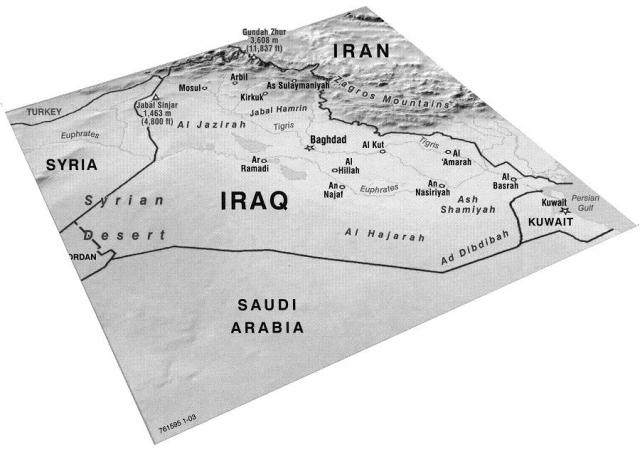 Figure 2. Map showing elevation contours around the Euphrates and Tigris Rivers that extend NW-SE through Mesopotamia.
Normally, in lesser storms most h2o runoff would take come primarily from the mountains in Syria and Turkey and non besides from Kingdom of saudi arabia and Iran. During the inundation, upstream where water showtime accumulates, the depth of water on the flood plains may be barely over the tops of the natural levees, but downstream the water "piles upward" because information technology does not flow very fast downhill on a nearly flat surface. Therefore, downstream water depths could attain 32 grand or more than above the tops of the levees.
This increase in depth would be intensified where the two flood plains with a width of 275 km in the northern section would be squeezed into a 220-km width in the lower office of the drainage system where the two rivers join. The joining of the two rivers would also increase the book of the h2o in the flood plains, thereby increasing the depth. At any rate, all higher country on the natural levees where the people in the villages were nowadays would be completely submerged. Thus, it would be possible for a flood to have occurred in mid- Mesopotamia, perhaps most 2900 BCE, as evidenced by the scientifically dated overflowing deposits.
Remnant Bear witness of the Alluvion
When the huge tempest ceased that caused the alluvion, in that location would take been huge lakes, and information technology could have taken months to drain the h2o in these lakes into the gulf — which could easily explain why the Noachian Overflowing took and so long to recede (as much as one year, according to Genesis 8:14). Evidence for this poor drainage tin can be seen in the present-day lakes in the inundation plains. Lake Hawr al Hammar is 32 km wide and more than 80 km long, lies on the flood plain of the Euphrates River west of Basra, and several other big lakes are on overflowing plains next to the Tigris River (for example, Hawr every bit Sa'diya and Hawr equally Saniyalt). The poor drainage would be caused past the fact that the water roofing the flood plains would have no channel through which to menstruation, would not flow uphill over the sloping natural levees to re-enter the river channels, and the slopes of the bottoms of the lakes would have been nearly flat with gradients toward the gulf of 0.025 to 0.075 meters per kilometer.
Effects of the Curvature of the Earth
Considering of the curvature of the globe, the horizon drops from where the viewer is continuing. However, the drib is proportional to the foursquare of the distance betwixt the viewer and an object on the horizon (Young nd). From these relationships, it tin exist seen that a tribal chief (or Noah) continuing on the deck of a large boat (Ark), perhaps seven.8 meters above the water,would not exist able to see the tops of any hills as high as 15 m from as niggling as 24 km away beyond flood plains covered with h2o because the curvature of the globe prevents it (Encounter the Appendix for examples of calculations). Almost hills in this region that are as much as xv grand loftier are more than 95 km away from the river levees. Therefore, the survivors of the Alluvion could see only h2o in all directions while they were floating downwards the Tigris River and over the flood plains. Many of these hills would also be partly covered with h2o which would make their tops project less above the water level, and therefore, the curvature of the earth would make them disappear from the line of sight in fifty-fifty a shorter distance than 24 km.
Northeast and southwest of the near flat surface that contains the two rivers, the topography rises to more than 455 m in Kingdom of saudi arabia and in Iran. Calculations show that elevations of 455 g loftier cannot exist seen beyond 86 km abroad, and these places are more than 160 km from the Euphrates or Tigris Rivers. Therefore, none of the high land in Saudi Arabia or Iran would exist visible to a tribal main (or Noah). On that basis, the "whole globe" would definitely appear to exist covered with water during the Flood, and that was the "whole earth" for the people in this office of southeastern Mesopotamia at that time.
Conclusions
If the iii.4-meter–thick layer of overflowing deposits in southeastern Mesopotamia (MacDonald 1988) represents a huge flood of ancient times, and if it is the remnants of the 1 described in the early Babylonian epics, and then the authors of these epics were probable survivors who lived in a village on natural levees on the lower parts of either the Euphrates or Tigris Rivers where the inundation waters covered their village, natural levees, and adjacent flood plains for distances of 160 to 320 kilometers so that no country could be seen, and their "whole world" would have been under h2o.
Acknowledgments
I wish to thank Kevin Collins, Fred Tonsing, Eugene Fritsche, Warren Hunt, Jarvis Streeter, Steve Peralta, and Barbara Collins for helpful comments that profoundly improved the manuscript.
Annotation
In the printed version, "Gilgamesh" erroneously appears in the 2d paragraph; it is replaced by the correct "Utnapishtim" here.
romanfamenceromed.blogspot.com
Source: https://ncse.ngo/yes-noahs-flood-may-have-happened-not-over-whole-earth
0 Response to "Will the Days of Noah Happen Again"
Postar um comentário